

Why Two Window Films with the Same TSER Can Feel Completely Different
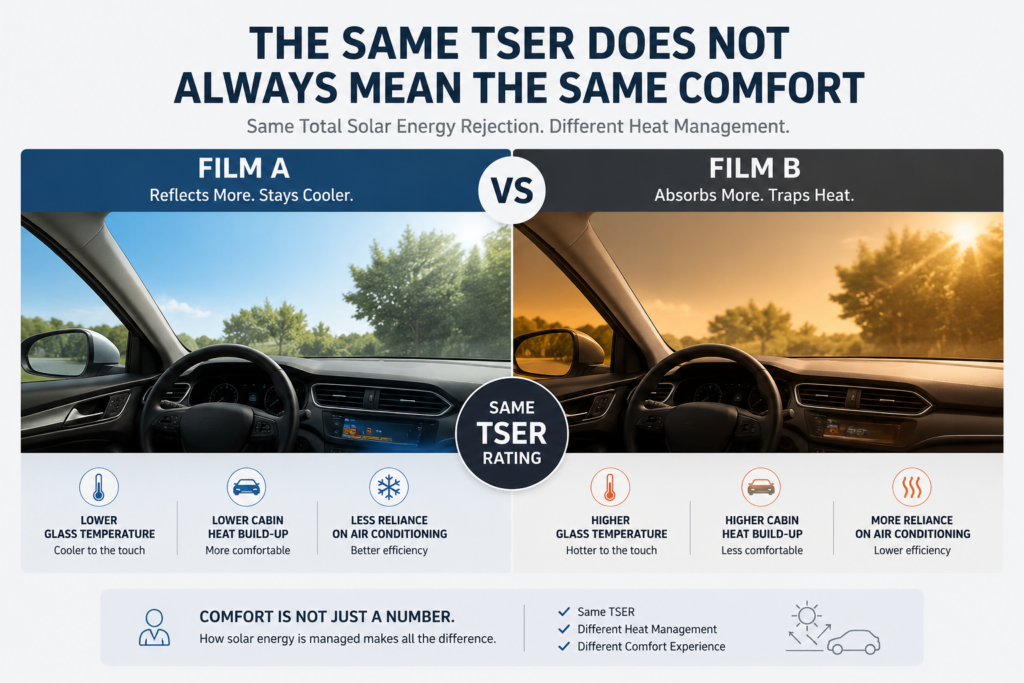
When comparing window films, many people assume that films with the same Total Solar Energy Rejection (TSER) should provide the exact same level of comfort. On paper, that seems reasonable. If two films reject the same percentage of solar energy, why would one vehicle feel noticeably cooler than the other?
The answer lies not only in how much energy is managed, but also in how that energy is managed by the film’s material structure.
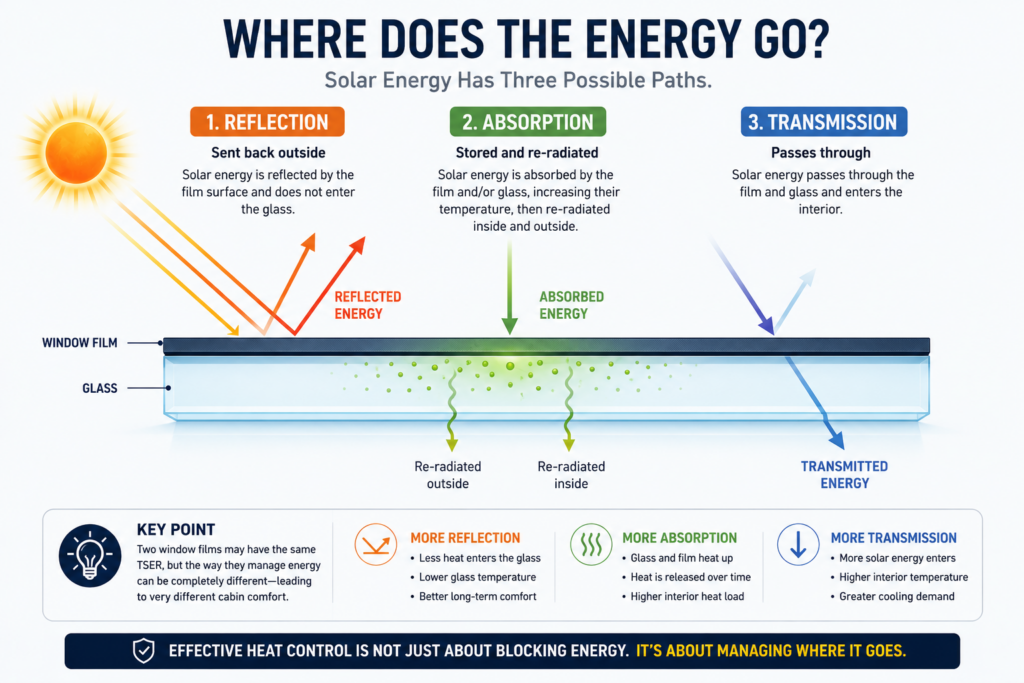
1. Solar Energy Does Not Become Heat Until It Is Absorbed
A common misconception in the automotive industry is that infrared radiation itself is “heat.” In reality, both infrared and visible light are forms of electromagnetic radiation carrying energy.
We only experience thermal heat when that energy is absorbed by a material—such as your car’s dashboard, seats, or skin—and converted into molecular motion.
This distinction changes how we evaluate window film performance. The key question is no longer simply:
-
How much energy is blocked?
But rather:
-
Where does that energy actually go?
2. Two Films Can Achieve the Same TSER in Different Ways
A TSER value tells us the total percentage of solar energy prevented from entering a vehicle or building. However, TSER does not explain the physical mechanism used to achieve that result. Different film constructions manage energy in fundamentally different ways:
-
Reflective Mechanisms: Some films reject a large portion of solar energy by reflecting it away from the glass immediately.
-
Absorptive Mechanisms: Others absorb a significant amount of energy within the film and glass structure itself, holding it before releasing it over time.
Although both approaches may produce identical TSER figures on a spec sheet, their real-world thermal behavior differs considerably.
3. Energy Rejection vs. Energy Absorption
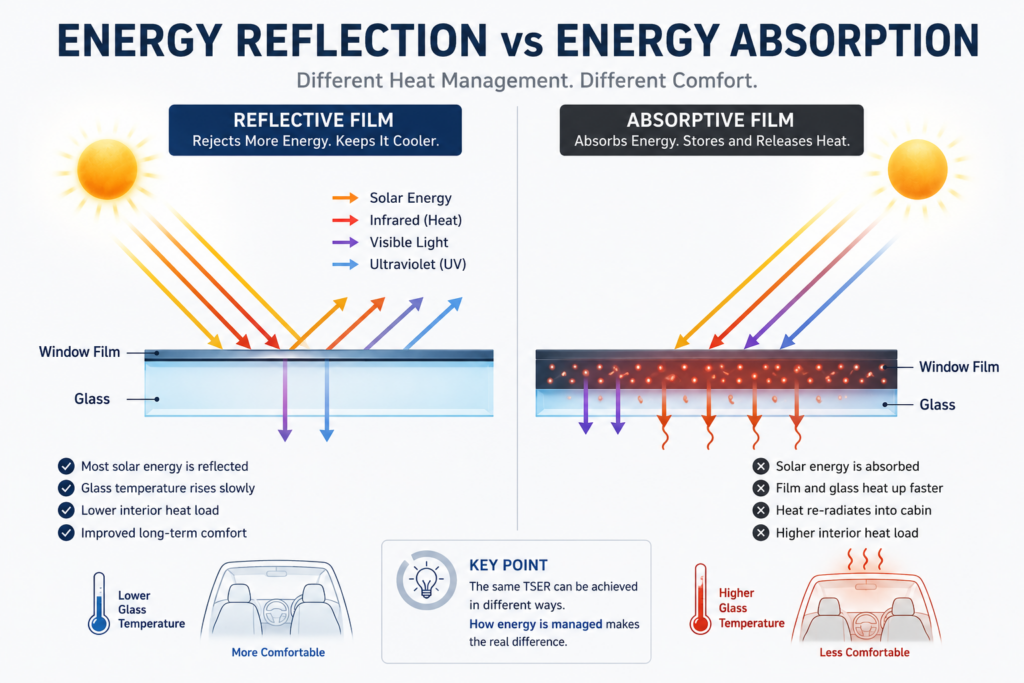
The balance between reflection and absorption is one of the most critical aspects of window film engineering.
High Reflection (Energy Rejection)
When more solar energy is reflected away before it penetrates the glass system:
-
Less energy remains trapped within the glass.
-
Glass surface temperatures rise much more slowly.
-
Interior-facing glass temperatures remain lower, reducing radiant heat.
High Absorption (Energy Storage)
In contrast, when a film relies heavily on absorbing energy:
-
The glass system stores a massive thermal load.
-
Surface temperatures increase rapidly.
-
Heat continues to be re-radiated inward into the cabin over time.
This is exactly why two films can share the same TSER value, yet create completely different thermal conditions inside the vehicle during a long drive.
4. Why Thermal Comfort Is More Than a Number
Drivers do not experience a lab-tested TSER percentage directly. Instead, they experience:
-
Accumulated cabin temperature.
-
Radiant heat emitting from the hot glass surfaces.
-
Long-term comfort during extended driving periods.
A film with strong energy absorption may perform flawlessly in short laboratory measurements, but it will create warmer interior glass surfaces during extended sun exposure. Meanwhile, a film engineered to reject more energy before absorption maintains a cooler glass system overall, leading to superior cabin comfort.
⚖️ Looking Beyond the Specification Sheet
While official specifications remain important, true thermal comfort cannot always be predicted by a single metric. When evaluating window films for real-world reliability, it is highly useful to look at the complete picture:
-
TSER Performance (The total energy benchmark)
-
Spectral Behavior (How it handles different wavelengths)
-
Energy Absorption Characteristics (How much heat it retains)
-
Energy Reflection Characteristics (How much heat it bounces away)
-
Long-Term Thermal Comfort (Performance after hours under the sun)
Conclusion
Two window films can share the exact same TSER rating while delivering completely different user experiences. The difference is rarely about how much energy is managed—it is almost always about where that energy ends up after it hits the film.
Effective energy management is not just about blocking solar energy; it is about controlling its destination.

The Dupotop Perspective
We don’t sell claims. We explain materials. Understanding how your film handles energy ensures you get the real-world comfort you expect, long after the vehicle leaves the installation bay.