

Understanding the Functional Surface Layer of Modern Paint Protection Film
When people think about Paint Protection Film (PPF), they usually focus on the TPU layer because it provides flexibility, impact resistance, and durability.
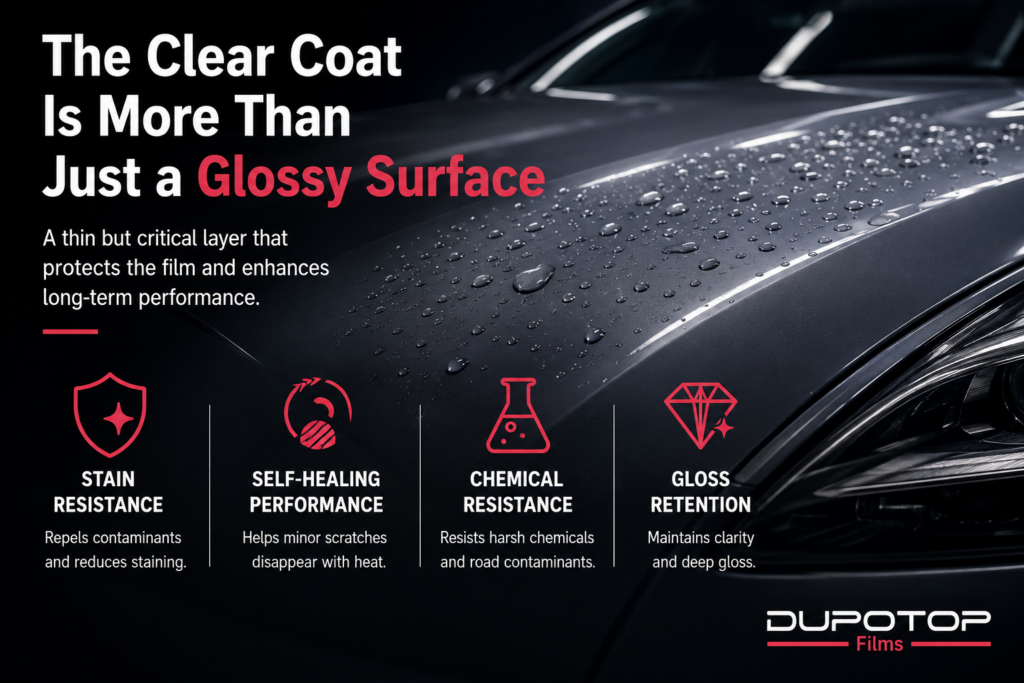
However, one of the most critical parts of modern PPF is actually the outermost layer—the clear coat.
Although it is extremely thin, this engineered surface layer plays a major role in determining how the film performs over years of real-world exposure.
It is not simply a glossy finish. It is a functional layer designed to protect the film itself.
What Is the Clear Coat?
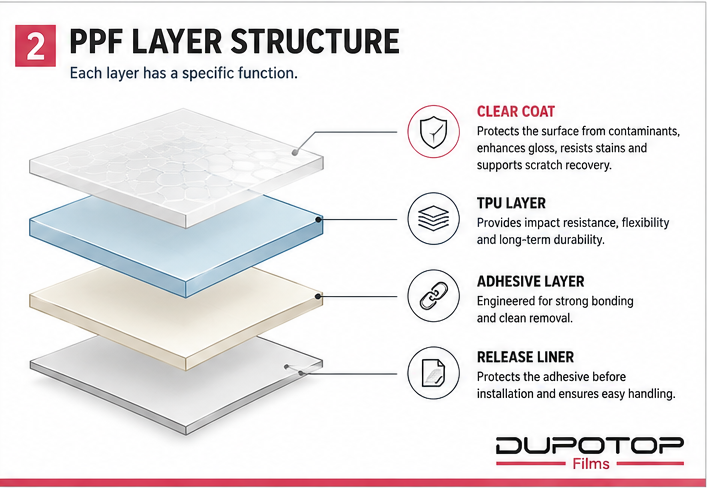
The clear coat is the transparent top layer applied over the TPU base film.
Unlike automotive paint clear coats, the clear coat on PPF is specifically engineered to improve the surface properties of the film while allowing the TPU underneath to maintain its flexibility.
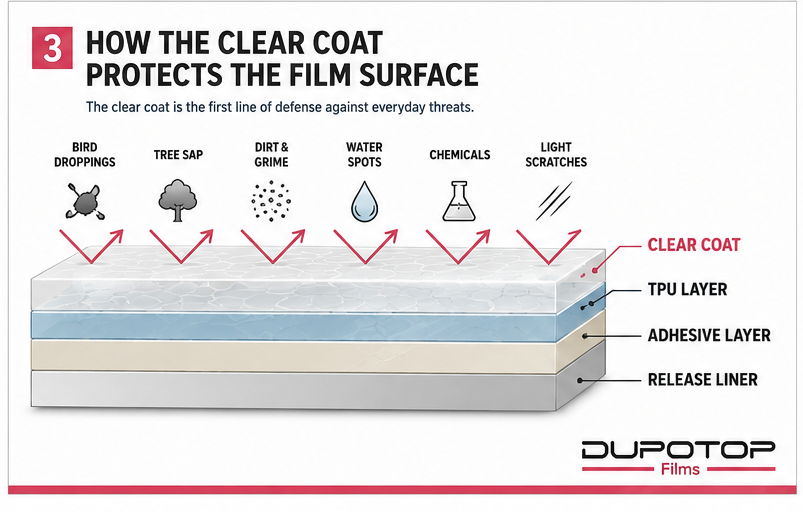
Rather than acting as decoration, it serves as the film’s first line of defense against everyday environmental exposure.
Why Isn’t TPU Alone Enough?
TPU offers excellent flexibility and impact absorption, making it an ideal base material for paint protection films.
However, TPU alone is not optimized for every surface challenge.
Without an engineered surface layer, the film may become more susceptible to:
- Surface contamination
- Chemical staining
- Dirt adhesion
- Loss of gloss over time
- Minor surface scratching
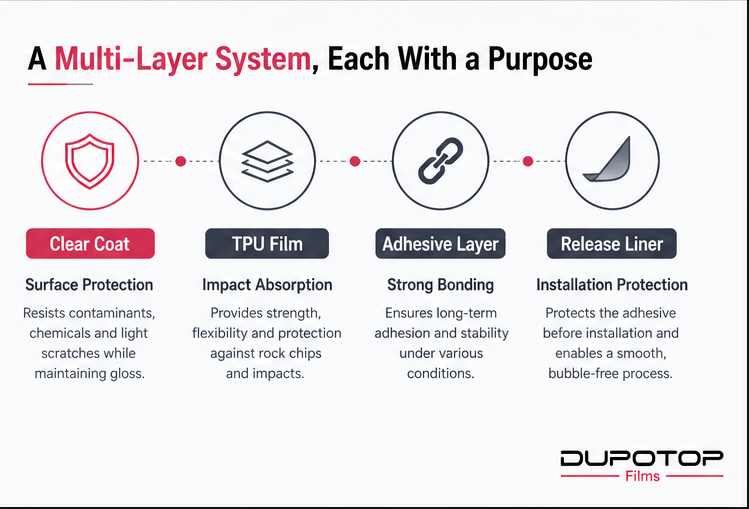
For this reason, modern PPF is designed as a multi-layer system, with each layer performing a specific function.
What Does the Clear Coat Actually Do?
Instead of simply covering the TPU, the clear coat is designed to improve the overall performance of the film.
Its functions commonly include:
Surface Protection
The clear coat provides the first barrier against contaminants that contact the film every day, including:
- Road grime
- Bird droppings
- Tree sap
- Water spots
- Chemical residues
Stain Resistance
Many modern clear coats are formulated to reduce surface staining.
By lowering the surface’s tendency to retain contaminants, cleaning becomes easier and long-term appearance can be better maintained.
Scratch Recovery
In many self-healing PPF systems, the clear coat is engineered with elastic polymer properties that allow very light surface marks to become less visible when exposed to heat.
The extent of this effect depends on the coating formulation and overall film construction.
Gloss Retention
A smoother and more stable surface helps maintain optical clarity and gloss after repeated washing and environmental exposure.
This contributes to a cleaner appearance throughout the service life of the film.
Chemical Resistance
Vehicles are exposed to a wide range of chemicals, including:
- Car wash detergents
- Bug removers
- Traffic film removers
- Fuel residues
- Acid rain
An engineered clear coat helps improve resistance to these common contaminants and reduces the risk of surface degradation.
Not All Clear Coats Perform the Same
Although many PPF products include a clear coat, their performance can vary considerably.
Differences in formulation, coating technology, curing processes, and manufacturing quality all influence characteristics such as:
- Surface smoothness
- Self-healing response
- Chemical resistance
- Stain resistance
- Long-term durability
This is why two films that appear similar initially may perform differently after years of outdoor use.
Looking Beyond Film Thickness
Film thickness is often discussed when comparing PPF.
However, thickness alone does not explain how the surface behaves during daily use.
The quality of the clear coat has a direct influence on how the film resists staining, maintains gloss, responds to minor scratches, and withstands environmental exposure.
Evaluating PPF therefore requires looking beyond a single specification and considering the engineering of the complete film system.
Conclusion
The clear coat is much more than a transparent finishing layer.
It is an engineered functional surface designed to enhance durability, maintain appearance, and improve the long-term performance of Paint Protection Film.
Understanding the role of the clear coat provides a more complete picture of how modern PPF is designed—not simply as a protective sheet, but as a carefully engineered multi-layer material system.
Dupotop Perspective
High-performance PPF is not defined by a single layer.
It is the result of multiple engineered layers working together, each designed for a specific purpose.
We don’t sell claims. We explain materials.