

TPU Materials in Paint Protection Film (PPF): Structure, Types, and Real-World Performance
Introduction: Why TPU Matters More Than Ever
In Paint Protection Film (PPF), performance is often discussed in terms of thickness, gloss, or surface coatings. However, the true foundation of PPF performance lies in the TPU (Thermoplastic Polyurethane) base material itself.
TPU is not a single material but a family of polymers whose properties vary significantly depending on their chemical structure. These structural differences directly influence durability, flexibility, weather resistance, installation behavior, and long-term appearance.
1. What Is TPU (Thermoplastic Polyurethane)?
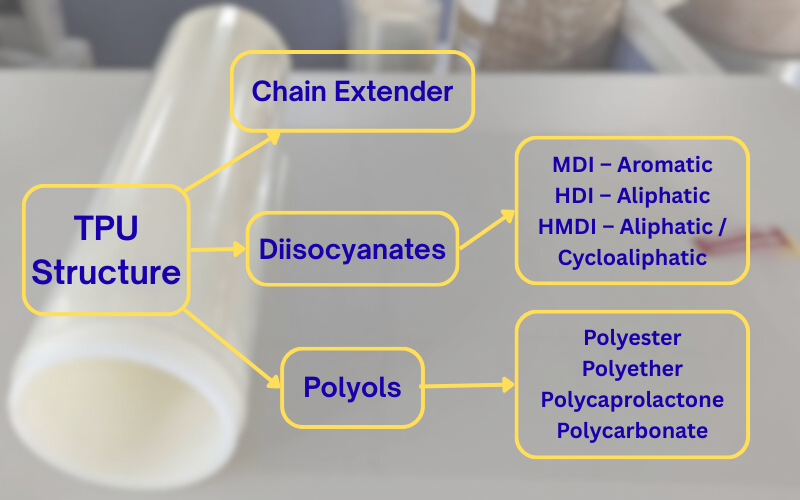
TPU is a high-performance elastomer formed by the polymerization of:
Diisocyanates, such as: MDI, TDI, HDI, and IPDI.
Polyols (soft segments).
Chain extenders.
Typical TPU characteristics include:
High elasticity and recovery.
Excellent abrasion resistance.
Wide hardness range (approximately 55A–72D).
2. TPU Structure: Hard Segments vs. Soft Segments
TPU performance is defined by the interaction of two structural components:
Hard Segments: Determine UV resistance, control yellowing behavior, and affect long-term outdoor durability.
Soft Segments: Define flexibility and stretch, influence hydrolysis resistance, and affect installation behavior.
3. Hard Segment Classification: Aromatic vs. Aliphatic TPU

Aromatic TPU (Sensitivity to UV)
Aromatic TPU uses aromatic diisocyanates such as MDI. While widely used in industrial applications, it is prone to yellowing under long-term sunlight, making it generally unsuitable for exterior automotive PPF.
Aliphatic TPU (The Foundation of Modern PPF)
Aliphatic TPU uses diisocyanates such as HDI and IPDI.
Key characteristics: Higher material cost, excellent UV resistance, and stable optical clarity.
PPF Relevance: Virtually all high-quality automotive PPF products use Aliphatic TPU.
4. Soft Segment Classification: Which TPU Types Truly Fit PPF?
I. Polyester-Based TPU
Strengths: High mechanical strength and abrasion resistance.
Limitations: Poor hydrolysis resistance; unstable in humid environments. Not suitable for long-term exterior PPF.
II. Polyether-Based TPU (The Mainstream Solution)
Common soft segments include PTMEG and PEG.
Advantages: Excellent hydrolysis resistance, high flexibility, and superior low-temperature performance.
PPF Relevance: Most mature PPF products balance durability and installability using Aliphatic Polyether TPU.
III. Polycaprolactone-Based TPU (Premium Material)
Characteristics: Combines advantages of polyether and polyester; strong abrasion resistance and hydrolysis stability.
PPF Relevance: Used in high-end PPF where premium durability is required.
IV. Polycarbonate-Based TPU (Emerging but Not Ideal)
While offering high weather resistance, it has practical limitations in PPF:
Stiffness: Leads to stress whitening under high stretch.
Installation: Higher rebound force makes edge wrapping difficult.
5. Material Selection Summary for PPF
From both material engineering and real-world installation perspectives:
Aliphatic Polyether TPU remains the most proven and stable solution.
Aliphatic Polycaprolactone TPU represents a high-end, performance-focused option.
Polycarbonate-based TPU presents practical limitations in flexibility.
Conclusion: The best PPF material is defined by balanced real-world performance across durability, clarity, and installability.