

How to Choose the Right Window Film Type for Different Projects
Introduction
Choosing the right window film type is essential for achieving the perfect balance of performance, aesthetics, and cost efficiency. Whether you’re an installer or a distributor, understanding the differences between film technologies can help you match the best product to every project — from entry-level applications to premium performance solutions.
1. Dyed Film: Low Cost and Budget Positioning
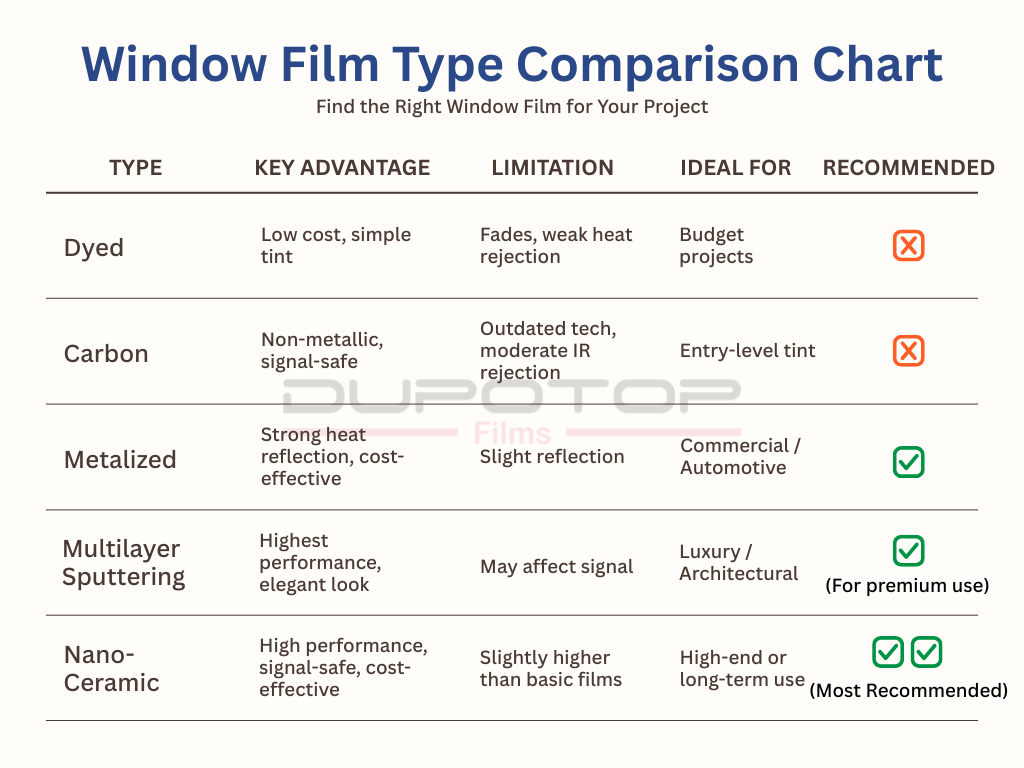
Dyed films are the most basic type of window film, using dye layers to absorb solar energy and reduce glare. They are affordable and easy to apply, making them popular for budget-conscious customers.
However, dyed films tend to fade over time and offer limited heat rejection, so they are best suited for short-term or low-cost installations.
Key advantages: low cost, soft appearance.
Limitations: color fading, weaker performance.
Ideal for: budget car tinting and temporary applications.
2. Carbon Film: Moderate Performance and Market Transition
Carbon films improve upon dyed films by using carbon particles that block infrared radiation. They offer darker shades without metallic shine and do not interfere with signals.
That said, carbon films are gradually being replaced by newer ceramic technologies due to limited infrared rejection and less durability compared to premium films.
Key advantages: non-metallic, signal-safe, better color stability than dyed films.
Limitations: moderate heat rejection, outdated technology.
Ideal for: entry-level automotive tint.
3. Metalized Film: Cost-Effective Heat Reflection and Durability
Metalized films contain microscopic metallic particles that reflect heat and UV radiation. Modern metalized films have improved significantly — earlier concerns about signal interference have largely been resolved through advanced coating processes.
They deliver strong heat rejection at a reasonable cost, making them suitable for both automotive and architectural projects.
Key advantages: excellent heat reflection, durable, cost-effective.
Limitations: slightly reflective look.
Ideal for: commercial buildings, cost-performance applications.
4. Multilayer Sputtering Film: Top-Tier Clarity and Performance
Multilayer sputtering films are made using advanced magnetron sputtering technology, layering different metals or metal oxides with nanometer precision.
They provide the highest heat rejection and optical clarity among all window films, while maintaining a sleek and premium appearance.
However, because these films still use conductive materials, they may interfere slightly with GPS or signal transmission.
Key advantages: top-tier performance, elegant appearance, superior optical clarity.
Limitations: potential signal interference, higher cost.
Ideal for: luxury architectural projects and high-performance automotive applications.
5. Nano-Ceramic Film: The Modern Standard for Profit and Reliability
Nano-ceramic films use non-metallic nanoparticles to block infrared heat while maintaining full signal transparency.
They deliver excellent heat rejection, UV protection, and color stability — all without the reflectivity of metalized films. Nano-ceramic films are now the preferred choice for installers seeking performance and reliability.
Key advantages: high infrared rejection, signal-safe, long-lasting clarity.
Limitations: higher price point.
Ideal for: high-end vehicles, residential and commercial projects.
Inventory Strategy: Matching Film Types to Market Demand
Budget projects: Dyed or Carbon Film
Balanced performance: Metalized Film
High-end appearance: Multilayer Sputtering Film
Top-tier performance: Nano-Ceramic Film
Each type serves a unique market segment. Distributors who carry a balanced product lineup can meet a wider range of customer needs while maintaining healthy profit margins.
Why Partner with Dupotop Films for Wholesale Supply
At Dupotop Films, we supply a full range of window films — from dyed and metalized options to advanced multilayer sputtering and nano-ceramic films.
Our products are manufactured with premium-grade PET base materials, ensuring durability, clarity, and long-term adhesion stability.
For distributors and installers, this means reliable supply, consistent quality, and competitive wholesale pricing — all backed by dedicated technical support.
Conclusion & Call to Action
Every project requires the right balance of protection, visibility, and aesthetics. By understanding the differences between film types, you can make smarter recommendations and deliver better results to your customers.
👉 Explore Dupotop’s full window film series and request your wholesale sample kit today:
https://dupotopfilms.com/window-film/
FAQ: Installer and Distributor Quick Q&A
Q1: Do metalized films still interfere with signals?
A1: Modern metalized films use refined coating technologies that greatly reduce signal interference, making them suitable for most modern vehicles and buildings.
Q2: Which film has the highest heat rejection?
A2: Multilayer sputtering and nano-ceramic films offer the best heat rejection performance.
Q3: Are dyed films still relevant in today’s market?
A3: Dyed films are useful for budget projects but have lower durability compared to newer technologies.
Q4: Which film type is best for B2B wholesale?
A4: Nano-ceramic films have become the most in-demand due to their balance of performance, longevity, and compatibility with modern installations.