

Why 99% UV Rejection Doesn’t Tell the Whole Story of Architectural Window Film
One architectural window film costs a few hundred ringgit. Another costs several thousand.
Both claim 99% UV rejection. Test them with a UV meter, and their readings may look almost identical.
So, why can the prices differ so much?
The answer is not necessarily brand name or marketing alone. The materials, adhesive system, manufacturing process and long-term durability can all contribute to the difference.
A UV rejection reading tells you about performance at the time of testing. It does not tell you everything about the materials inside the film or how well they will withstand years of sunlight.
One important factor worth understanding is the UV absorber.
1. UV Absorbers: An Invisible Line of Defence
Architectural glass brings natural light into buildings, but sunlight can also contribute to the fading and ageing of curtains, furniture, flooring and other interior materials.
Architectural window film helps manage UV transmission, depending on its construction and specifications. Some film formulations also incorporate UV absorbers into the adhesive or other polymer layers.
When UV radiation reaches these absorbers, they absorb specific wavelengths and convert the energy through molecular processes, typically releasing it as heat.
This helps reduce the amount of UV energy reaching the materials that need protection.
But here is the important point: absorbing UV radiation is only part of the job. The absorber must also maintain its effectiveness over time.
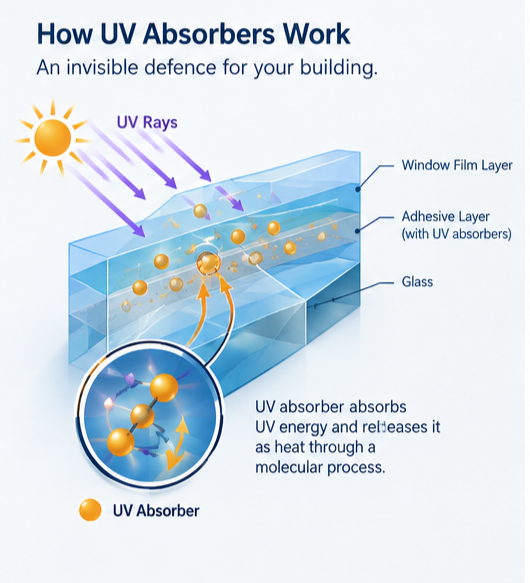
Different UV absorber chemistries can vary in absorption range, photostability and compatibility with the surrounding materials. These differences are worth examining when evaluating the long-term performance of architectural window film.
2. Salicylate vs Triazine: What Is the Difference?
Salicylates and triazines are two different chemical families used in UV absorber technology.
Some cost-focused formulations may use salicylate-based absorbers, while higher-performance formulations may use advanced triazine-based absorbers where long-term weathering resistance is a priority.
The difference lies not simply in whether they absorb UV radiation, but in how their specific chemical structures perform under prolonged exposure.
Salicylate-Based UV Absorbers
Salicylates are an established family of UV-absorbing compounds.
However, UV absorbers are not permanent. Depending on the specific compound and formulation, prolonged UV exposure can cause photochemical changes that reduce their effectiveness.
As the UV stabilisation system loses performance, the surrounding polymers and adhesive materials may become more vulnerable to UV exposure and heat, potentially accelerating material ageing.
This is why the initial UV rejection reading alone cannot tell the full story.
Triazine-Based UV Absorbers
Certain triazine-based UV absorbers, particularly hydroxyphenyl triazines, are known for their strong UV absorption and excellent photostability in suitable polymer and coating formulations.
Their molecular structure allows them to absorb UV energy and dissipate it through an energy-conversion process, helping the molecules return to a state in which they can absorb energy again.
This process can repeat, although it does not mean the material will never degrade.
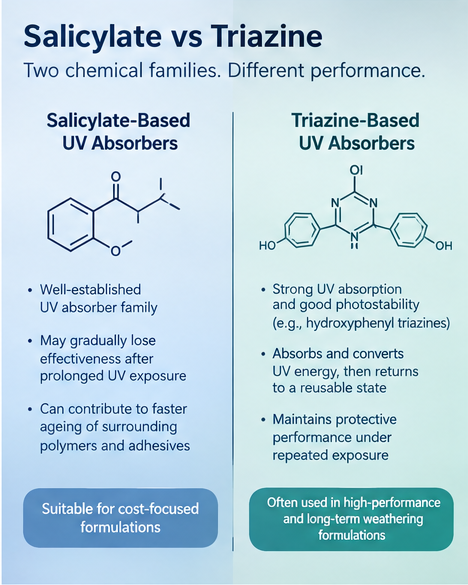
In simple terms, a good UV absorber must do more than absorb UV radiation when the film is new. It should also maintain its protective performance through repeated exposure to sunlight.
That is one reason advanced UV absorber technology can matter in applications where long-term weathering resistance is important.
Of course, the final result still depends on the specific absorber, its concentration, the adhesive formulation and the overall film construction. The chemical family alone does not determine the quality of an entire product.
3. Why Do Some Architectural Window Films Bubble or Delaminate Over Time?
Architectural window films are exposed to sunlight, elevated glass temperatures and changing environmental conditions throughout their service life.
Over time, these conditions can contribute to material ageing. If the adhesive loses its bonding performance, the film may develop bubbles, peeling or delamination.
Many people immediately blame the adhesive when this happens. Adhesive quality is certainly important, but the wider material system also deserves attention.
UV absorbers help reduce the effects of UV radiation on susceptible materials. If the stabilisation system loses effectiveness, the film and adhesive may become more vulnerable to photodegradation.
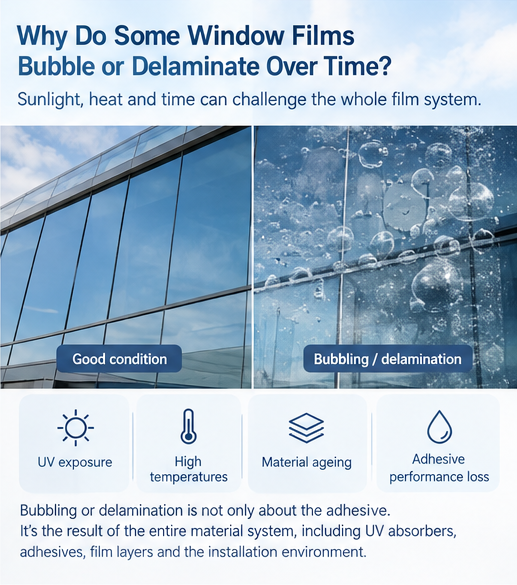
However, bubbling does not automatically mean that the UV absorber has failed first. Installation quality, adhesive formulation, material compatibility and the conditions in which the film is used can all affect the outcome.
Long-term durability depends on the complete film system, not on one ingredient alone.
For building owners, contractors and installers, this is an important consideration when evaluating window film for offices, commercial buildings and large glazed facades.
4. Is 99% UV Rejection Enough to Judge Architectural Window Film?
UV rejection is an important specification, but it represents only one aspect of window film performance.
When comparing products, consider the following:
-
UV rejection: Are the test results clear, and were the products tested under comparable conditions?
-
Material technology: What type of UV absorber and stabilisation system does the formulation use?
-
Weathering performance: Is there supporting data from weathering or accelerated ageing tests?
-
Adhesive compatibility: Are the film layers and adhesive designed to work together?
-
Project suitability: Is the film appropriate for the existing glass, sunlight exposure and intended application?
-
Product assurance: Are the specifications, warranty terms and quality controls clearly defined?
For architectural projects, it is also important to consider solar heat control, visible light transmission (VLT), glass compatibility and the building’s daylight requirements.
A film that performs well in one application may not be the best choice for every building. Product selection should be based on the complete set of performance requirements, not a single number.
Conclusion: The Same Number Does Not Mean the Same Material
Two architectural window films can both achieve 99% UV rejection when new. That does not prove they use the same materials, nor does it guarantee that they will maintain identical performance after years of exposure.
The test result tells you what the film achieves under the test conditions. Understanding the material technology helps explain why products may differ in long-term stability and durability.

When choosing architectural window film, look beyond the number. Consider the materials, formulation, weathering performance and suitability for the project.
At Dupotop, we believe in understanding the material, not just the marketing claims.