

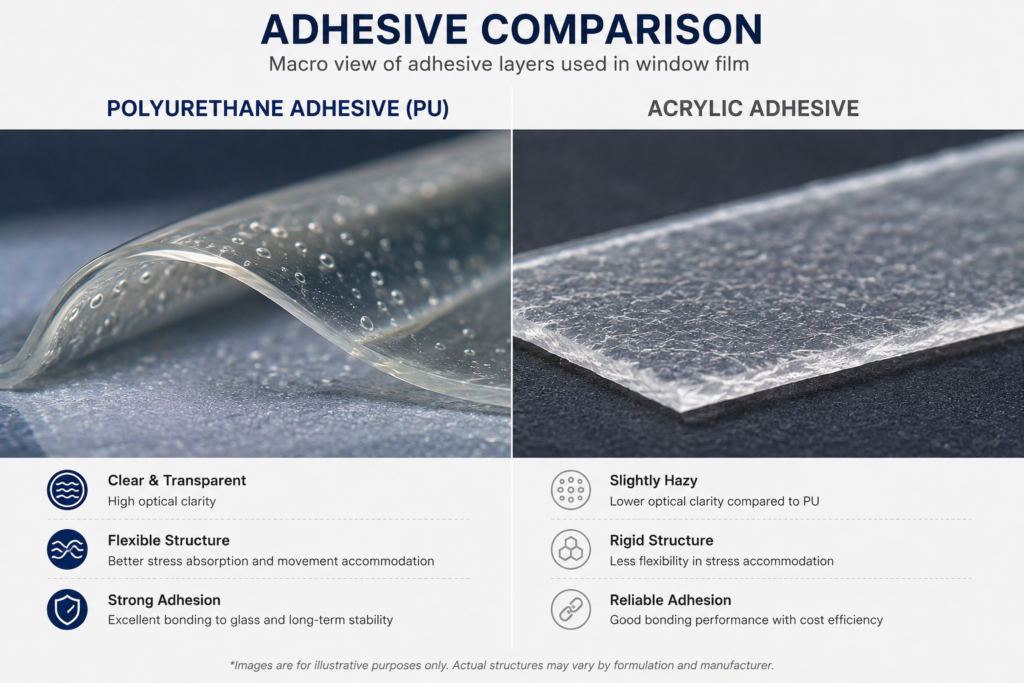
Why Do Premium Window Films Pay More Attention to Adhesive?
Polyurethane vs. Acrylic Adhesive in Window Film
When choosing a window film, most people look exclusively at standard performance metrics: VLT, IRR, TSER, and UV Rejection.
However, there is another critical component that is frequently overlooked: the adhesive.
Although completely hidden once installed, the adhesive is responsible for permanently bonding the film to the glass. Furthermore, it heavily dictates installation behavior, optical performance, and long-term structural stability. Two primary adhesive systems dominate the market today: Acrylic Adhesive and Polyurethane (PU) Adhesive.
So, why are PU-based adhesives almost exclusively associated with premium window films?
1. Acrylic Adhesive: Mature, Practical, and Cost-Effective
Acrylic adhesive is a well-established pressure-sensitive adhesive (PSA) technology widely used across various film industries.
Its primary advantages include:
Relatively lower manufacturing and material cost.
Mature, predictable manufacturing technology.
Easily adjustable adhesion properties.
Good optical clarity for standard applications.
Ideal for large-scale, high-volume production.
For cost-oriented window films, acrylic adhesive provides a practical balance between performance, manufacturing efficiency, and price. This is why it is widely used in mainstream and budget-focused window tint lines.
Note: This doesn’t mean acrylic adhesive cannot perform well; its overall performance still heavily relies on chemical formulation and overall film design.
2. Why Do Premium Films Use PU Adhesive?
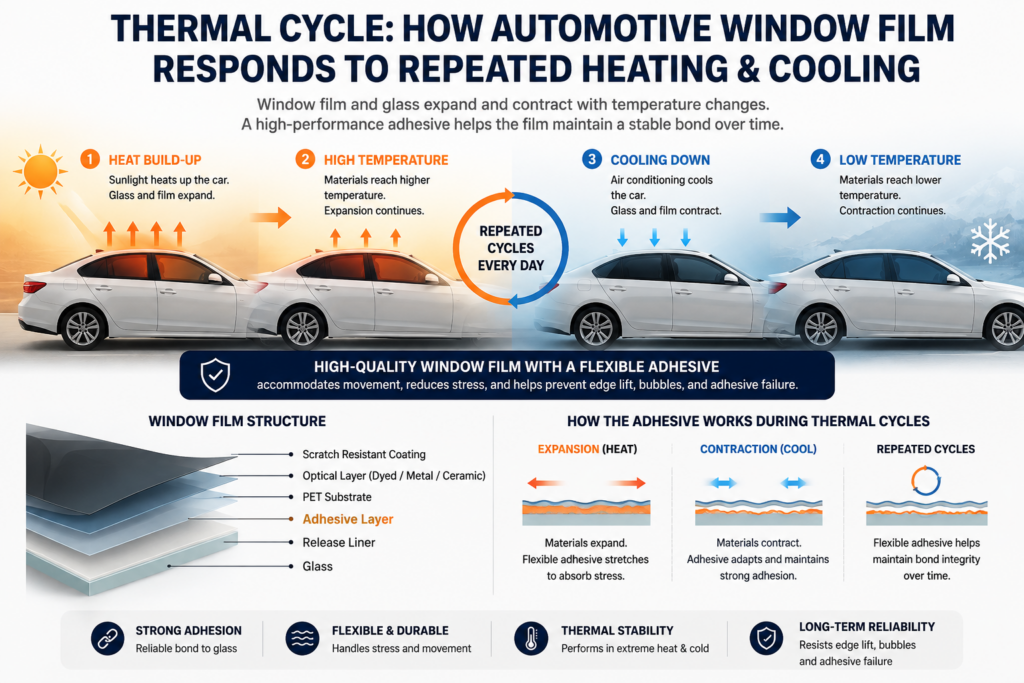
Automotive window film undergoes severe and continuous environmental stress—most notably, repeated temperature cycles:
The glass and the film respond differently to these constant temperature fluctuations. The adhesive layer must dynamically accommodate this thermal movement while maintaining a stable, uncompromised bond.
A well-engineered Polyurethane (PU) adhesive provides greater inherent flexibility and superior stress accommodation. This resilience against thermal expansion and contraction is precisely why PU-based adhesive systems are the gold standard for premium automotive window films.
3. Why Can Installers Feel the Difference?
The adhesive layer doesn’t just dictate long-term durability; it completely changes how the film feels during application. Installers immediately notice differences in:
Initial Tack: How quickly and securely the adhesive grabs the glass surface during positioning.
Repositionability: How smoothly the film can be lifted and adjusted before final squeegeeing.
Water Release: How the adhesive matrix handles and expels slip solution during installation.
Final Adhesion: How reliably the film anchors down, particularly around complex dot matrix patterns and tight edges.
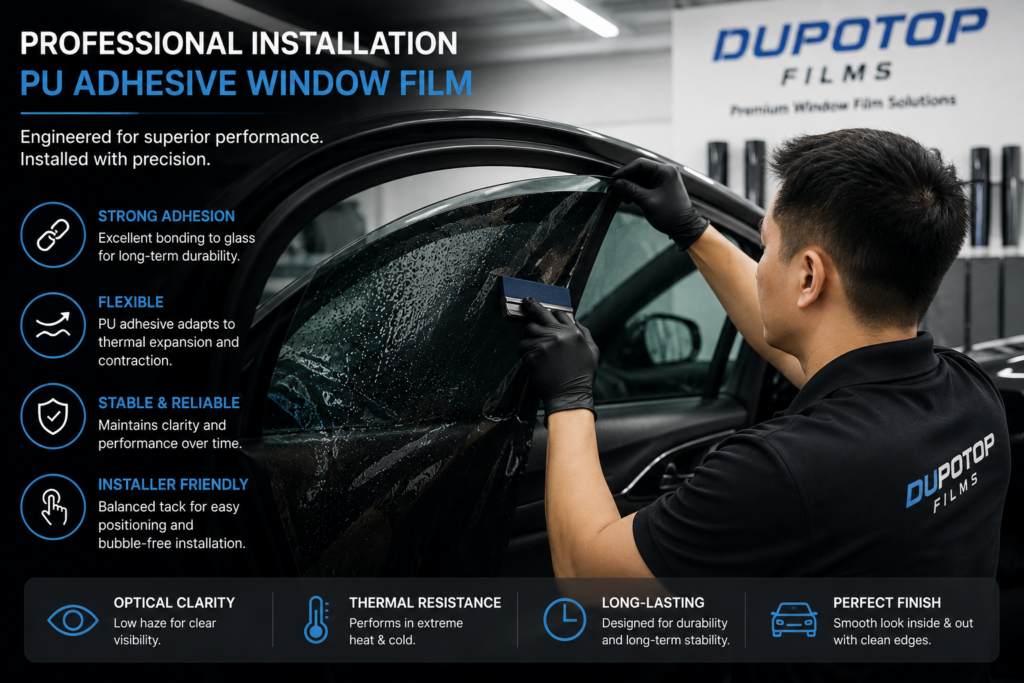
This explains why two films with identical spec-sheet numbers can feel completely different under a professional’s squeegee. The adhesive is a major reason why.
📊 Acrylic vs. PU Adhesive: Quick Comparison
| Property | Acrylic Adhesive | Polyurethane (PU) Adhesive |
| Material Cost | Lower | Higher |
| Technology Maturity | Extremely well-established | Advanced / Specialized |
| Market Use | Widespread / Mainstream | Mid-to-high-end / Premium |
| Flexibility | Formulation-dependent | Generally stronger potential |
| Thermal Stress Accommodation | Fair to good | Superior / Long-lasting |
| Optical Clarity | Excellent | Excellent |
Acrylic creates a practical balance between cost and baseline performance.
PU is engineered for products designed around high flexibility, extreme thermal stress tolerance, and elite durability.
Conclusion: Don’t Look at IRR Alone
Infrared Rejection (IRR) is important, but it is only one chapter of the story. A complete, high-performance window film system requires analyzing multiple variables working in unison:
The next time you evaluate a window film, don’t just ask:
“What’s the IRR?”
Also ask:
“What type of adhesive does it use?”
Because while the adhesive may disappear from sight after installation, it remains the silent backbone of how your film performs over years of intense exposure.
The Dupotop Perspective
Good film performance starts with good material design. We don’t sell claims. We explain materials.